Home
UniAbuja Land Battle Escalates: Staff, Students Block Gate, Seek Tinubu’s Intervention

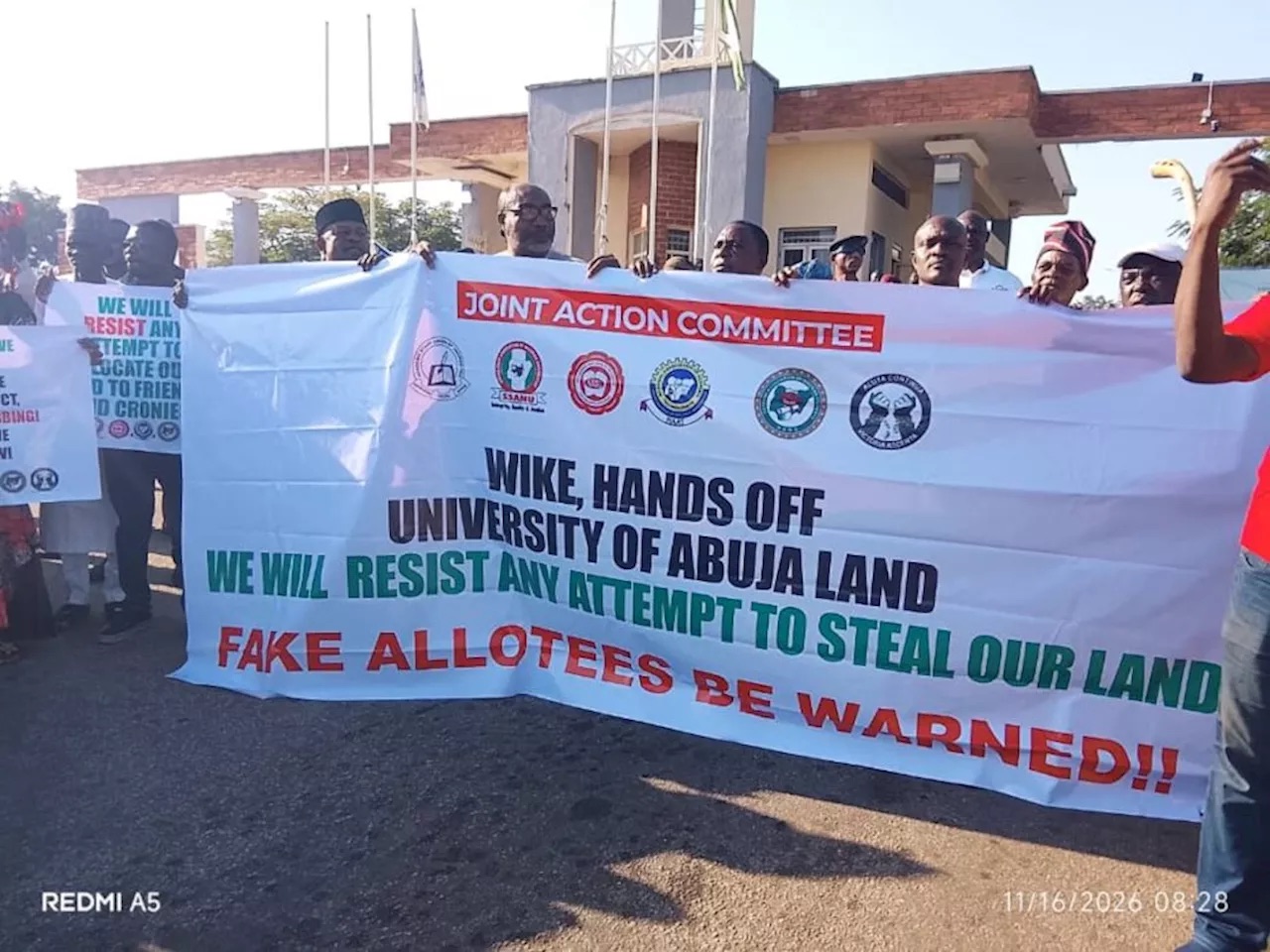

Staff and students of the University of Abuja blocked the institution’s main campus entrance on Monday, November 16, protesting the alleged allocation of portions of its land to private developers by the Federal Capital Territory Administration under Minister Nyesom Wike.
The demonstration brought together lecturers, non-academic workers, students and alumni, who demanded the reversal of the disputed allocations and called on President Bola Tinubu to intervene. They warned prospective developers to stay away from the property, insisting that land reserved for the university’s growth must be protected.
Members of the Academic Staff Union of Universities, the Senior Staff Association of Nigerian Universities, the Non-Academic Staff Union of Educational and Associated Institutions, and the Students’ Union Government participated in the protest.
Carrying placards and chanting solidarity songs, the demonstrators accused the FCT Administration of putting private development interests ahead of the institution’s future. Their demands centred on restoring the disputed land and preventing further development on it while the disagreement remains unresolved.
The dispute concerns portions of an expanse of approximately 11,824 hectares in the Giri District, which university union leaders say was allocated to the institution for academic expansion, agricultural research and infrastructure.
ASUU’s position is that the university’s land requirements must be assessed against its long-term responsibilities. The union argues that space without buildings today may still be needed for future faculties, research facilities and other projects.
Before Monday’s demonstration, the university’s ASUU chapter had warned that continued disagreement over the allocations could threaten industrial harmony on campus.
Speaking during the protest, ASUU branch chairman, Professor Sylvanus Ugoh, argued that the institution serves a public purpose and should retain the space needed to fulfil its mandate. He urged Tinubu to intervene and ensure that the university’s development interests were protected.
NASU branch chairperson, Sadiya Hassan, also questioned the disputed allocations, saying the institution had projects requiring land. She argued that development efforts should help address the university’s needs.
SSANU branch chairman, Nurudeen Yusuf, said specialised teaching and research programmes required substantial space, including appropriate separation around certain research facilities.
Students linked the land controversy to existing accommodation and infrastructure pressures. Their representatives said insufficient hostel spaces had pushed many students into off-campus housing, where rising rents were adding to their financial burden.
They maintained that reducing the university’s available land could limit its ability to provide accommodation and facilities as its population grows. Alumni representatives also raised concerns about campus security and the implications of private development around university property.
Wike has previously rejected allegations of land grabbing and defended the FCT Administration’s authority to regulate land allocation and enforce Abuja’s development plans.
During a November 5 media chat, the minister challenged ASUU’s authority to determine land ownership and questioned the justification for retaining thousands of hectares without sufficient development. He maintained that the administration’s decisions formed part of its responsibility to ensure proper land use.
He also rejected pressure through strike threats and said the FCT Administration was prepared to defend its position in court.
The opposing positions have left the dispute centred on a critical question: how to reconcile the university’s future expansion needs with the FCT Administration’s land management decisions.
For the protesting university community, Monday’s blockade marked an escalation from warnings to collective action. Participants pledged to sustain pressure for federal intervention and a reversal of the alleged allocations.
Share this:




